What Volusia County, Florida Buyers Need to Know About Flood Zones Before Making an Offer
What Volusia County Buyers Need to Know About Flood Zones Before Making an Offer
By Kalie Luckenbaugh | Kalie Has the Keys | Volusia County Real Estate
If you've been searching for a Realtor in Volusia County who actually understands flood zones and flood insurance, you're already ahead of most buyers. A lot of people don't think to ask about this until they're sitting at a closing table staring at a premium they weren't expecting. I want to help you avoid that.
Here's the honest, practical breakdown of everything you need to know about flood insurance when buying a home in Volusia County.
Why Flood Zone Matters in Volusia County
Volusia County is not just a coastal market. Yes, we have the beach, but we also have the St. Johns River, the Tomoka River, the Intracoastal Waterway, and miles of inland waterways that put properties in flood zones you might never expect. Volusia County has experienced numerous flood-related events and multiple federally declared disasters over the past several decades, reinforcing that flooding is a real and recurring risk for local property owners.
The home you're looking at might carry more risk than it appears from the street.
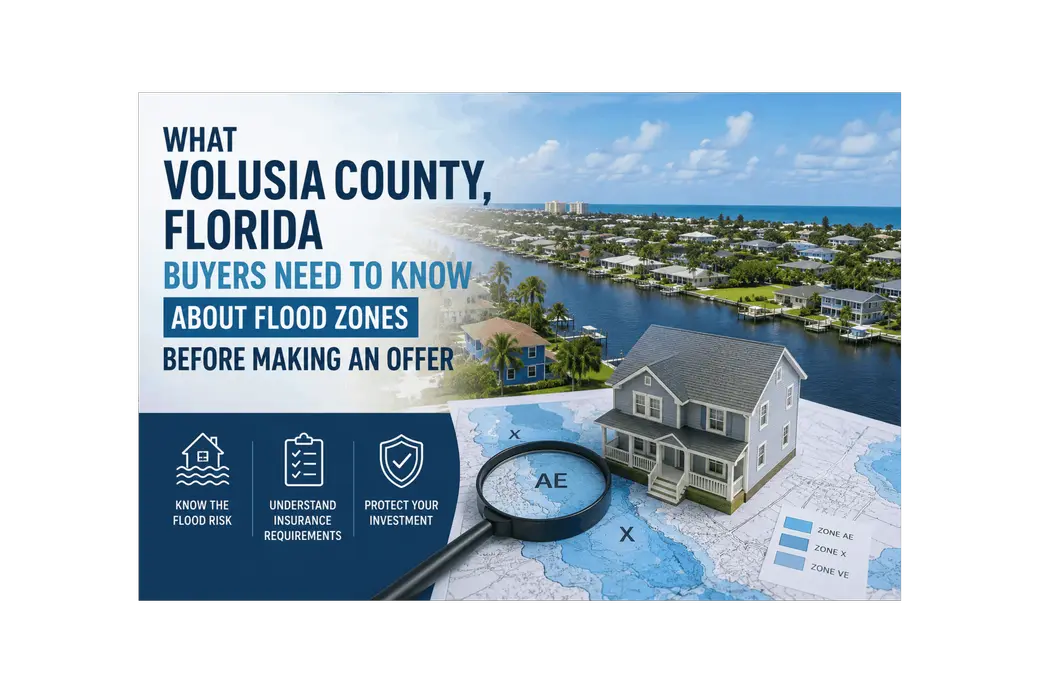
FEMA assigns every property in Volusia County a flood zone designation. Here's what those zones actually mean:
Zone AE: High risk. There is a 1% annual chance of flooding, also called the 100-year floodplain. If you have a federally backed mortgage on a property in Zone AE, flood insurance is required. Period.
Zone VE: Very high risk. These are coastal properties where flooding comes with wave action on top of rising water. This is the most expensive zone to insure.
Zone X (Shaded): Moderate risk. This is the 500-year floodplain. Flood insurance is not required here, but it is recommended, and for good reason. More on that in a minute.
Zone X (Unshaded): Lower risk. Outside major floodplains. Flood insurance is not required but is still available and worth considering.
Here's what most buyers don't know: over 20% of all National Flood Insurance Program claims come from low and moderate-risk areas. Being outside a high-risk zone does not mean flooding cannot happen to your home.
What Flood Insurance Actually Costs in Florida
Florida flood insurance costs vary widely depending on your zone, your property's elevation, your coverage amount, and whether you go through the federal program or a private insurer.
The federal program, called the National Flood Insurance Program (NFIP), averages around $938 to $1,363 per year for a single-family home in Florida depending on the property specifics. However, rates have been rising under FEMA's newer pricing system called Risk Rating 2.0, which went fully into effect in 2023. Under this system, some Florida policyholders saw premium decreases while others experienced increases depending on their property's specific flood risk. For existing policyholders, annual increases are capped at 18% per year. New policyholders must pay the full current rate right away.
Private flood insurance has also expanded significantly in Florida and sometimes offers lower premiums than the NFIP depending on your specific property. It is always worth getting quotes from both before assuming you know what your premium will be.
One critical thing to know: NFIP policies generally have a 30-day waiting period before coverage takes effect, although certain exceptions may apply for property purchases and lender-required coverage. This is not something to leave until the week before closing. Address it early in your home search.
An NFIP policy covers up to $250,000 in structural damage and up to $100,000 for your personal belongings. If you need coverage beyond those limits, private flood insurance or an excess flood policy can fill the gap.
The FEMA 50% Rule: The Thing Nobody Tells Buyers
This is one of the most important things I tell every buyer who is looking at a home in a flood zone, and one of the least talked-about topics in real estate. If you are buying a home in a Special Flood Hazard Area, the FEMA 50% Rule could completely change what you are allowed to do with that property after closing.
Here is how it works.
If the cost of a renovation, remodel, or addition equals or exceeds 50% of the home's pre-improvement market value (not including land), the project triggers what FEMA calls "substantial improvement." At that point, the entire structure must be brought into full compliance with current floodplain management regulations. That almost always means elevating the foundation to meet the Base Flood Elevation for that zone. Depending on the home, that can cost tens of thousands of dollars on top of whatever renovation work you had planned.
The same rule applies to damage. If a home in a flood zone suffers storm, flood, or fire damage and the cost to repair it exceeds 50% of the structure's market value, the home is classified as "substantially damaged" and must be brought up to current flood code before rebuilding. It does not matter whether the damage was caused by flooding or something else entirely.
What catches buyers off guard is this: it does not matter what you are renovating. A kitchen remodel, a bathroom addition, a structural repair after a storm, all of it counts toward that threshold. And here is the part that really surprises people: multiple smaller projects can add up over time. Some local jurisdictions track cumulative improvements over a set period, meaning several smaller projects could eventually push you over the 50% mark and trigger full compliance requirements.
Why does this matter when you are buying?
If you are looking at a lower-priced home in a flood zone that needs work, you need to know this before you make an offer. A home that looks like a great deal on paper can become a very expensive project once you factor in what it would cost to renovate and comply with flood code at the same time. An older home sitting below Base Flood Elevation in Zone AE or VE is the most common scenario where this rule becomes a major issue.
Before writing an offer on a fixer-upper in a flood zone, I always recommend getting a contractor's rough estimate of renovation costs and comparing that to an independent appraisal of the structure's current value. That comparison tells you whether you are at risk of triggering the rule before you are committed to the purchase. It is also worth noting that local floodplain administrators, not FEMA directly, are the ones who ultimately determine how the substantial improvement rule is applied, and implementation can vary slightly by jurisdiction.
Florida's Flood Disclosure Law: What Sellers Must Tell You
This is something that changed significantly in 2024 and was expanded again in 2025, and it works in your favor as a buyer.
As of October 1, 2024, Florida law requires sellers to complete a separate Flood Disclosure form and provide it to you before the sales contract is signed. This form requires sellers to disclose whether the property has ever had flood damage, whether they filed an insurance claim for flood damage, and whether they received any federal disaster assistance related to flooding.
Effective October 1, 2025, the law was expanded even further under Senate Bill 948. Sellers must now disclose any known flooding during their ownership, not just insurance claims or federal assistance. Landlords renting properties on leases of one year or longer are also now required to provide a flood disclosure to tenants.
The disclosure requirement gives buyers more information before purchasing a property and may create legal consequences for sellers who knowingly fail to disclose required flood history. A good Realtor makes sure you receive this disclosure and actually walks you through what it says before you sign anything.
What a Flood Zone Designation Means for Your Purchase
When I pull a property for a buyer in Volusia County, one of the first things I check is the flood zone. Here's why it matters beyond just the insurance premium:
Your mortgage lender will require it. If the home is in Zone AE or VE and you have a federally backed mortgage, your lender will require proof of flood insurance before closing. This is not optional.
It affects your offer strategy. A home in a high-risk flood zone with an older FEMA map might be reassigned to a lower zone, which could dramatically reduce your insurance costs. An elevation certificate from a licensed surveyor can sometimes show that a home sits higher than the FEMA map indicates, which can lower your premium. This is worth knowing before you make an offer.
It affects what you can do with the home after you buy it. See the 50% Rule section above. This is the piece most buyers skip until it is too late.
It can affect resale. Buyers who come after you will face the same questions. A home with a flood history or in a high-risk zone needs to be priced accordingly and marketed correctly.
Flood zone maps are periodically updated. FEMA reviews and updates flood maps on an ongoing basis, and portions of Volusia County have been subject to map review and revision efforts in recent years. A property's flood zone designation today is not necessarily permanent. Staying on top of map changes is part of what I do for my clients.
Citizens Insurance and the Flood Insurance Requirement
If your home is insured through Citizens Property Insurance, Florida's insurer of last resort, there is something specific you need to know. Citizens has been phasing in mandatory flood insurance requirements, and by January 1, 2027, essentially all personal residential Citizens policies that include wind coverage will require flood insurance regardless of flood zone. Properties in Special Flood Hazard Areas already face earlier requirements. All Citizens policyholders whose homes are in a Special Flood Hazard Area must carry flood insurance regardless of their coverage amount.
This is not a small detail. If you are buying a home currently insured through Citizens and you are not aware of this requirement, you could face a gap in coverage that your lender discovers at the worst possible time. Make sure your insurance costs reflect this requirement from day one.
What I Do Differently as Your Realtor
When you work with me, here is what you actually get on the flood side of things:
I check the FEMA flood zone designation on every property before we go see it, not after you fall in love with it. I walk you through the flood disclosure before we write an offer so there are no surprises. I flag older homes in flood zones where the 50% Rule could become a factor, and I connect you with the right contacts to get renovation cost estimates and insurance quotes before you are under contract. And I know enough about Volusia County's waterways, neighborhoods, and flood history to have an honest conversation with you about risk rather than just handing you a form and moving on.
I also work closely with my lending partner Lindsay Ackerman at Motto Mortgage Signature Plus, who factors flood insurance costs into your monthly payment estimates from the start so your budget is accurate and there are no surprises at the closing table. She can be reached at 386-523-7695 or Lindsay.Ackerman@MottoMortgage.com.
Frequently Asked Questions
Do I have to buy flood insurance if the home is not in a high-risk zone? Not always. If the property is in Zone X and you have a conventional mortgage, it is typically not required. However, more than 20% of flood insurance claims come from lower-risk zones, so it is worth a conversation with your insurance agent.
What if the seller says the home has never flooded? That is a start, but it does not tell the whole story. Ask for the flood disclosure form required by Florida law. Also ask whether there is an elevation certificate on file and what the current flood insurance premium is. Past history does not guarantee future results, especially as FEMA continues updating flood maps across Volusia County.
Can I shop around for flood insurance or am I stuck with NFIP? You can absolutely shop around. Private flood insurance has expanded meaningfully in Florida and sometimes offers lower premiums, higher coverage limits, and shorter waiting periods than NFIP. Getting quotes from both is always the smart move.
What is an elevation certificate and do I need one? An elevation certificate is a document prepared by a licensed surveyor showing the exact elevation of your home relative to the Base Flood Elevation in your area. It can help insurers more accurately assess risk and may lower premiums for some properties. Not every property has one on file, but they can be ordered.
What is the FEMA 50% Rule and does it apply to me? If the home you are buying is in a Special Flood Hazard Area (Zone AE or VE) and you plan to renovate or if the home has any prior storm damage, the 50% Rule could apply. If the cost of your renovation or repair equals or exceeds 50% of the structure's pre-improvement market value, the entire home must be brought up to current flood code, which typically means elevating the foundation. Ask me about this before you make an offer on any flood zone property that needs work.
How long does it take to get flood insurance? NFIP policies have a 30-day waiting period. Private flood policies may have shorter waiting periods. Do not wait until the week before closing to start this conversation.
My Take
Buying in Volusia County means buying in a market that is beautiful, diverse, and genuinely worth it, but one where understanding your flood risk is not optional. The good news is that with the right Realtor guiding you, this does not have to be scary. It just has to be handled correctly from the start.
If you are looking at homes in Port Orange, South Daytona, Daytona Beach, Ormond Beach, or New Smyrna Beach and you want to work with someone who checks the flood zone before you check the square footage, I would love to connect.
📞 386-285-4081 📧 Kalie.luckenbaugh@gmail.com 🔑 Kalie Has the Keys
Kalie Luckenbaugh is a licensed Florida Realtor with Real Broker LLC serving the greater Volusia County area. This blog is for informational purposes only and does not constitute legal, financial, or insurance advice. Please consult a licensed insurance agent and your local floodplain administrator for guidance specific to your property.
Sources: FloodZoneMap.org. "Volusia County, Florida Flood Zones." floodzonemap.org JRH Engineering. "Volusia County FEMA Flood Zone Updates 2026." jrhengineering.net, May 2026. Insurify. "A Guide to Florida Flood Insurance (2026)." insurify.com, May 2026. NerdWallet. "Flood Insurance in Florida: What to Know." nerdwallet.com, May 2026. Florida Realtors. "Florida Expands Flood Disclosures." floridarealtors.org, September 2025. Florida Realtors. "New Flood Disclosure Requirements in Florida." floridarealtors.org, June 2025. Nasseh Law PLLC. "Florida's 2025 Flood Disclosure Law." nassehlaw.com, November 2025. VIP Adjusting. "FEMA 50% Rule Explained: Substantial Damage and Flood Claim Requirements." vipadjusting.com, September 2025. Revolution Florida. "FEMA 50% Rule Florida: Substantial Improvement Guide." revolutionflorida.com, February 2026. Charlotte County, FL. "50% FEMA Rule." charlottecountyfl.gov
Categories
Recent Posts